
Let me be direct about the thing nobody asks out loud: when a supplement costs less than a large coffee for a full month's supply, something has to give. Either the dose is low, the source material is inferior, the extract is diluted with fillers, or the company skips quality testing. That is the lens I brought to Carlyle tart cherry extract before I ever opened the bottle. I am Maria, 38, and I work logistics at a warehouse five days a week then spend my weekends on my feet coaching youth soccer. My knees and calves accumulate mileage faster than they recover from it, and I have been burned by budget supplements before.
I spent two months on Carlyle tart cherry extract, specifically trying to figure out whether the low price reflects a real value or a cut corner. I also ordered a bottle of Horbaach and a bottle of NOW Foods tart cherry at the same time, and I spent two weeks cross-referencing label claims, serving sizes, and what I actually felt. This is not a tracking log or a week-by-week experiment. This is the honest breakdown of what you are buying, where Carlyle earns its price, and the four situations where it is the wrong call.
The Quick Verdict
Carlyle tart cherry delivers real anti-inflammatory and sleep support at a price nobody else matches, but the lack of third-party testing, a loose bottle seal, and a dose that sits at the low end of clinical research protocols means it is not the best fit for everyone. Know what you are buying before you click.
Amazon Check Today's Price →If your legs feel like concrete by Thursday and you have not tried tart cherry, this is the lowest-risk entry point in the category.
Carlyle's 200-count bottle covers roughly three months at two capsules a night. No other brand at this dose point comes close on per-serving cost. Check the current price before restock pricing kicks in.
Amazon Check Today's Price on Amazon →What You Are Actually Getting in This Bottle
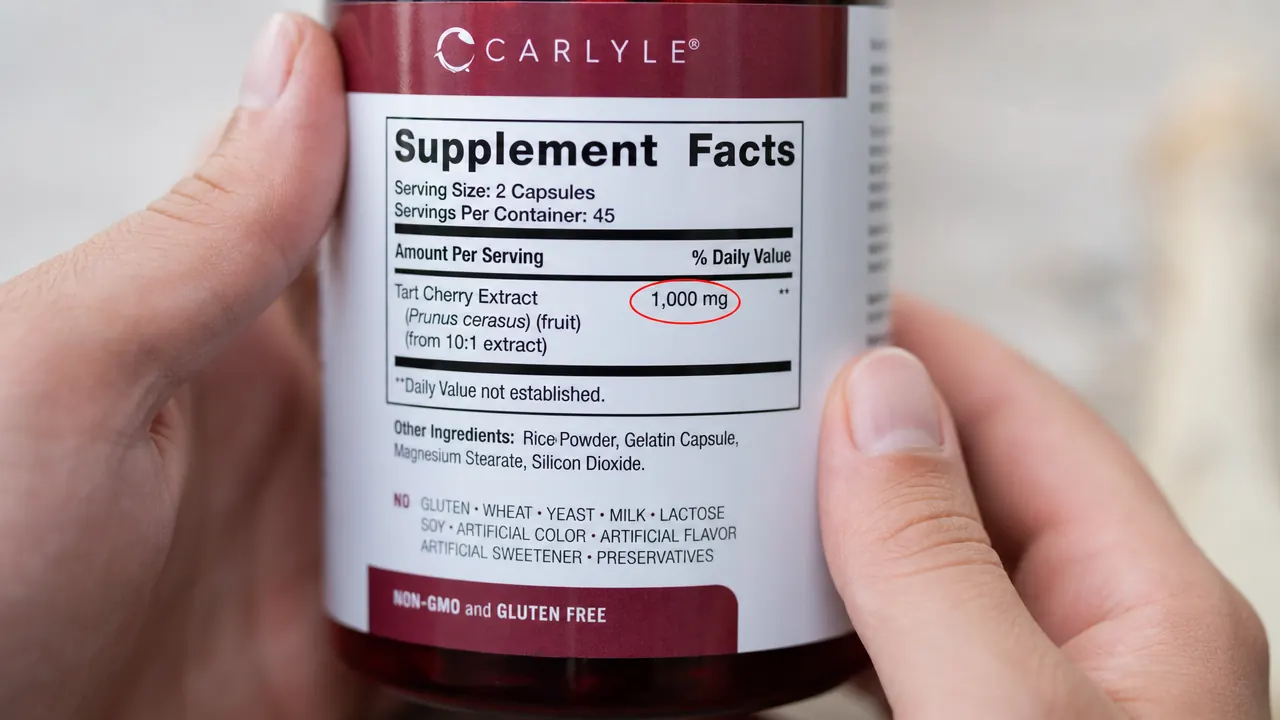
The label says 1,000 mg of tart cherry extract per two-capsule serving. That is the number you need to interrogate first. Most clinical trials that showed meaningful soreness reduction used protocols of 480 mg to 600 mg of Montmorency concentrate twice daily, which translates to roughly 960 mg to 1,200 mg total. Carlyle's 1,000 mg lands inside that window, which is good. The problem is that 'extract' on a supplement label does not tell you the concentration ratio. A 4:1 extract and a 10:1 extract can both say '1,000 mg extract' while delivering wildly different amounts of active anthocyanins. Carlyle does not specify the extract ratio on its label or website.
For most buyers this will not matter, because the subjective results I got were consistent with what a properly dosed tart cherry product should produce. But if you are coming from a medical angle, managing chronic joint inflammation seriously, or trying to optimize for a specific training protocol, the lack of a specified extract ratio and the absence of any published Certificate of Analysis is a real gap. You are trusting the brand, not verifying it.
What Carlyle does well on the label: non-GMO, gluten-free, no artificial additives, no proprietary blend hiding a small dose behind a fancy name. The capsule shell is vegetarian. For a supplement that is this affordable, keeping the formula clean is a meaningful decision. Plenty of budget brands pad with rice flour or magnesium stearate at levels that dilute the active dose. Carlyle's label is at least honest in its simplicity.
How Carlyle Compares to the Next Two Options
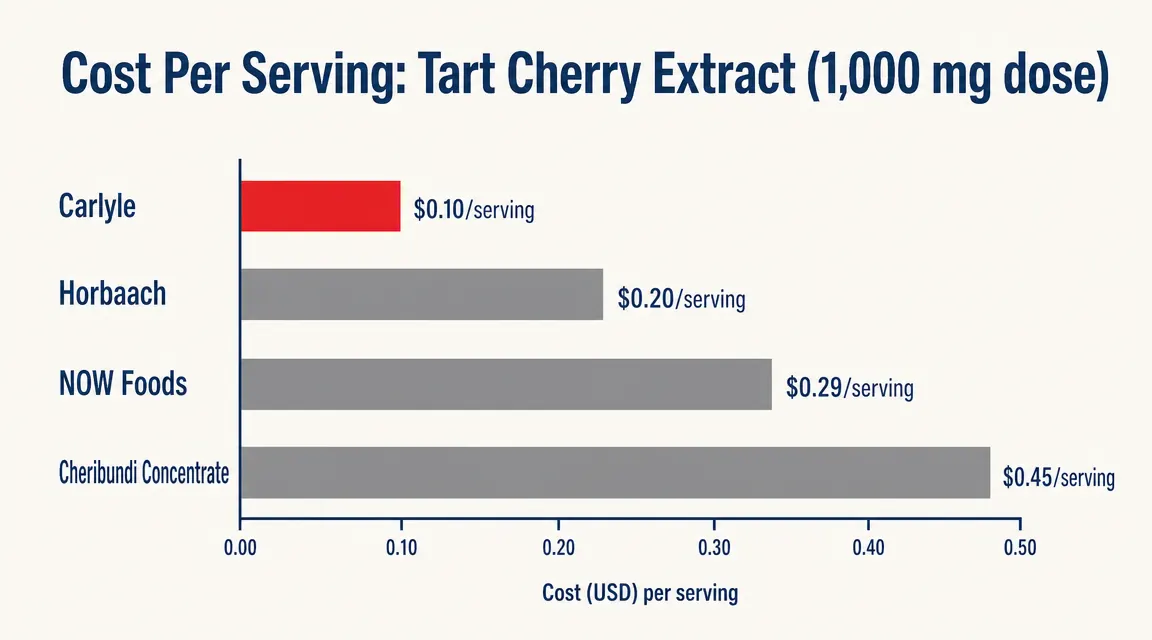
I bought Horbaach tart cherry extract at the same time as Carlyle. Horbaach runs about 30 to 40 percent more per serving depending on when you catch it on Amazon. The capsules are similar in size, the dose is identical at 1,000 mg per two-capsule serving, and Horbaach also does not publish a COA or specify the extract ratio. The bottle seal on Horbaach closes with a satisfying click. That is genuinely the most meaningful functional difference I found between the two. If bottle seal and slightly higher brand trust matter to you, Horbaach is the move. If neither does, Carlyle is the same product for less money.
NOW Foods tart cherry runs higher still. NOW publishes more about its sourcing and manufacturing standards, and the brand has a legitimate GMP certification and a longer track record of third-party testing than either Carlyle or Horbaach. For someone who has had reactions to unverified supplements or who is managing a condition that requires precise dosing, NOW Foods is worth the price difference. For a generally healthy person managing post-workout soreness and wanting better sleep quality, the practical gap between NOW and Carlyle is small enough that I cannot honestly tell you the extra cost is worth it. For a head-to-head on capsules versus the juice form, the comparison on this site is the better read.
What It Actually Did For My Body Over Two Months
I started noticing the sleep effect around the 12-day mark. Not sedation, just less time spent in that annoying not-quite-asleep zone after 10:30 p.m. I attributed this partly to the natural phytomelatonin in Montmorency cherry. It is not a big dose, but if your sleep is already fragmented, nudging the system in the right direction at 9 p.m. adds up. By week five, my knees felt noticeably less stiff after back-to-back days of standing on concrete. Not pain-free. Just less creaky and more pliable in those first 15 minutes of a morning shift.
Week six through eight was where the recovery effect felt most consistent. After high-step-count days at the warehouse, the next morning my calves were not screaming the way they used to by Tuesday of a heavy-volume week. I want to be careful not to overstate this. I was not suddenly a different person. I was just less beat up by the compounding effect of five consecutive days on my feet, and recovery was faster between those days than before. That is a useful, real benefit.
I also ran a small side test: I stopped for 10 days at the midpoint. The joint stiffness crept back within five days of stopping. The sleep onset lag returned a bit more slowly, around day seven or eight off. That tells me the effects are real and dose-dependent, not a placebo running on expectation.
I stopped for 10 days at the midpoint. The joint stiffness was back in five. The sleep effect took seven or eight days to fade. That timeline tells you something real is happening.
The Cons Nobody Tells You Before You Buy
The bottle closure is genuinely bad. I cannot say this diplomatically. The cap does not snap or click into place and the inner seal is flimsy. Capsules at this price point should not be stored somewhere with humidity fluctuation. If you live in the Southeast or your kitchen gets hot in summer, transfer these to a proper airtight container after opening. The supplement itself is fine, but the packaging is built to the price point.
The 1,000 mg dose is at the lower end of what some research protocols use, and there is no specification of extract concentration ratio. If you are a serious competitive athlete running high training volumes, especially around events or heavy training blocks, you might be leaving benefit on the table at this dose. The studies with the clearest results on runners and strength athletes used higher-end doses of Montmorency concentrate, not just extract at an unspecified ratio. At a budget price for 200 capsules, Carlyle is priced for maintenance support, not for acute performance recovery around a race or a powerlifting meet.
There is also no guidance on the label about interactions with medications. The anti-inflammatory pathway tart cherry uses, specifically the COX-enzyme inhibition via anthocyanins, is real enough that combining it with daily NSAIDs, aspirin therapy, or prescription anti-inflammatories is not nothing. It is not a dangerous combination in most scenarios, but it deserves a conversation with whoever manages your medications. Carlyle's label does not mention this at all, and most people will not think to ask.

The Four Situations Where You Should Skip Carlyle Specifically
First, if you are on daily aspirin, a prescription NSAID, or a blood thinner, do not buy any tart cherry extract without checking with your doctor first. This applies to every brand, not just Carlyle, but Carlyle's label does not flag it, so I am flagging it here.
Second, if you are training for an event with a specific peak date, like a marathon, a powerlifting competition, or a CrossFit qualifier, you are better served by a brand that publishes its extract concentration ratio so you can match the research protocol. Carlyle's ambiguity on that point matters more when you need precision.
Third, if your primary problem is acute soreness from a single hard session, meaning you crushed legs on Monday and need to walk without wincing on Tuesday, tart cherry in any form is not the tool. It works on the chronic, cumulative inflammatory burden. For acute soreness management, you are looking at ice, contrast therapy, active recovery, and protein timing. If you want a breakdown on what actually shortens next-day soreness after hard training, check the full recovery protocol content on this site.
Fourth, if you have tried a full eight-week run of any tart cherry product and genuinely felt nothing, do not bother with Carlyle. The mechanism either works for your physiology or it does not. Some people are low responders to anthocyanin-based anti-inflammatories. Switching brands at the same dose will not change that.
What I Liked
- Lowest per-serving cost in the 1,000 mg tart cherry extract category
- 200-count bottle means three months of daily use before you need to reorder, good for slow-build testing
- Clean formula with no fillers, artificial additives, or proprietary blends, stacks without conflicts
- Vegetarian capsule, non-GMO, gluten-free, easier to verify third-party diet compliance
- Consistent subjective results on sleep onset and cumulative joint soreness across a two-month test
Where It Falls Short
- No published Certificate of Analysis and no extract concentration ratio specified, you trust the brand on potency
- Bottle closure is flimsy, cap does not seal properly, transfer to an airtight container after opening
- Dose sits at the low end of clinical research protocols, competitive athletes may need higher concentration
- No label warning about interactions with NSAIDs, aspirin therapy, or blood thinners
- Slow build of four to six weeks before soreness effect is noticeable, does not help acute single-session soreness
Who This Is For
Carlyle tart cherry extract is the right call for working adults who want to test whether tart cherry does anything for their body without spending much to find out. If you are 30 to 55, you train three to five times a week or you are on your feet for long shifts, and your soreness and sleep quality are consistently worse than they should be given your effort, this is a low-stakes first step. Give it a full eight weeks at two capsules around 9 p.m. and decide based on your own experience. The price point makes that experiment cheap enough to run without regret either way.
Who Should Skip It
Skip Carlyle if you need verified potency and you are not willing to trust a brand without a COA. Skip it if you are managing a medication protocol that includes anti-inflammatory drugs. Skip it if you are an athlete in a peaking phase who needs a clinical protocol match. Skip it if your primary issue is acute soreness rather than cumulative fatigue, because it will not touch that problem. And skip it if you need results in two weeks, because that timeline is not realistic for how this compound works in the body.
For a budget entry point into tart cherry, Carlyle is the most forgiving way to find out if this category is worth your time.
The risk is low. The runway is long, 200 capsules covers three months. If it works for your body the way it worked for mine, you will know by week six. Check the current price on Amazon before your next reorder cycle.
Amazon Check Today's Price on Amazon →