

I drove a forklift for six years before a disc issue turned sciatica from a word I'd heard into something that woke me up at 3 a.m. The shooting pain down my left leg, the lower back that locked up every time I stepped out of the cab, the way the last two hours of every shift felt like punishment. I tried every stretch I found on YouTube the night before work and still showed up barely functional. So this isn't a guide from someone who read about sciatica. This is what I actually worked out, shift by shift, over about four months of trial and a lot of error.
The problem with most sciatica advice is that it's built for people who can lie on the floor and stretch for 20 minutes at a time. That's not a work shift. You have a truck to load, a floor to cover, a patient to see. You need strategies that fit in a break room, a cab, or 90 seconds between tasks. That's what these five steps cover. They work when you're moving and when you're stuck sitting. None of them need gear, except the Sparthos lumbar back brace I now wear for the heaviest hours of every shift, which has made the single biggest difference.
The back support I wear for every long shift , because ignoring sciatica at work doesn't work.
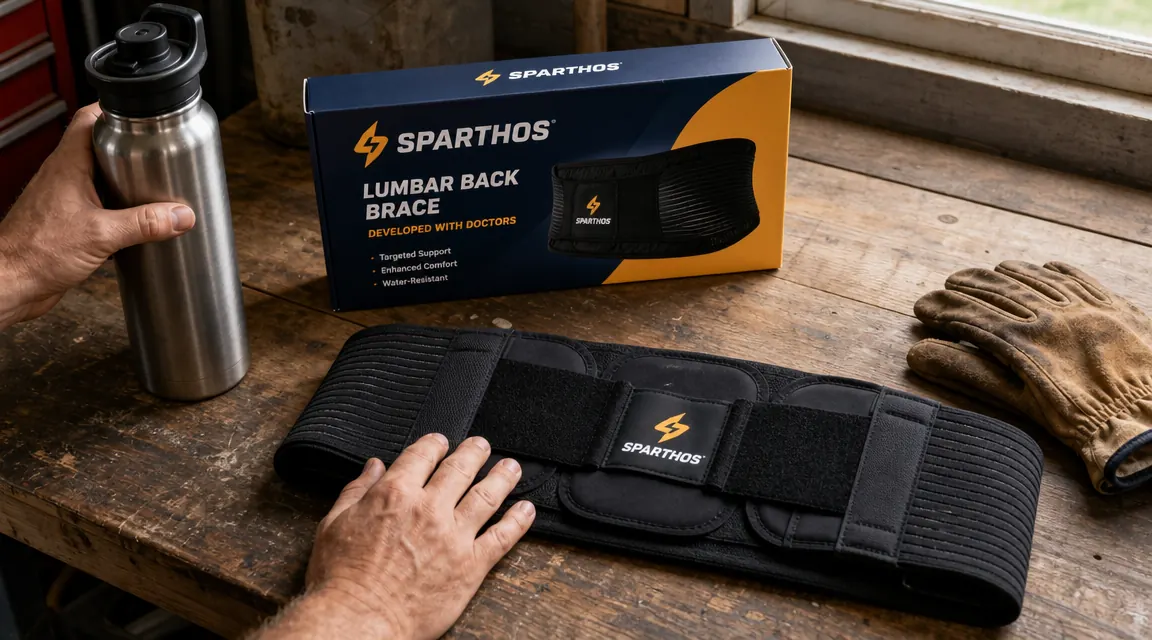
The Sparthos lumbar back brace sits at 4.4 stars across nearly 67,000 reviews. It's the thing I actually wear on hard days. Breathable enough for physical work, firm enough to feel like it's doing something. I wear mine from the moment I get into work clothes until I get home.
Amazon Check Today's Price on Amazon →Step 1: Brace Before the Pain Starts, Not After
This was the first thing I got wrong. I kept waiting until my back hurt to put on the Sparthos brace. By then, the sciatic nerve was already irritated and the brace was playing catch-up. The shift in thinking that helped: treat it like a knee brace before a game, not a bandage after an injury. Put it on when you get dressed for work, before you load a single thing or sit behind a wheel for the first hour.
The Sparthos brace has a removable lumbar pad that pushes right into the L4-L5 area where most sciatica originates. When it's cinched correctly, it limits the flexion that jams the disc into the nerve. The key word is correctly. Most people wear it too loose. You want it snug enough that you can feel it resisting when you round your lower back, not so tight that you can't take a breath. I tighten mine two notches tighter than feels comfortable at first and loosen it slightly after 30 minutes when the muscles warm up.
The breathable mesh on the Sparthos matters more than I expected. I tried a cheap neoprene brace in the summer and soaked through it by noon. The mesh version stays drier and I'm not pulling it off by hour four to get relief from the heat. That consistency is where the benefit lives.
Step 2: Fix the Position You're In for the Longest Hours
Whether you drive a truck for eight hours or stand behind a counter, there's one position you're in more than any other. For drivers, it's the seated position with both feet on the pedals and the seat adjusted wrong. For most people driving with sciatica, the problem is that the seat is too far back and the hips drop lower than the knees. That posture flattens the lumbar curve and pinches exactly where you don't want pressure. Move the seat forward until your hips and knees are at roughly the same height. If you drive a commercial truck and can't easily adjust the seat, a firm wedge cushion does the same job.
For people who stand all day, the single biggest fix is weight distribution. Most people with sciatica unconsciously shift weight to the less painful side and over time that imbalance makes the tight piriformis muscle worse. Practice standing with weight even on both feet, even when it's uncomfortable on the symptomatic side, and use a rubber anti-fatigue mat if your employer allows it. One hour on a proper mat versus a concrete floor is a night-and-day difference for sciatic nerve load.
Step 3: Use the 20-Minute Rule for Movement Breaks
Sitting compresses the discs and irritates the nerve. Standing too long without movement does the same thing through a different mechanism. The sweet spot is breaking position every 20 minutes, not 45, not when you remember. Set a phone timer if you have to. When the timer goes off, you do three things: stand up if you've been sitting, walk 30 steps, then do a standing hip hinge. That's it. Under 90 seconds total.
The standing hip hinge looks like this: feet shoulder-width, soft bend in the knees, push your hips back behind you like you're closing a car door with your backside, keep your spine neutral. Hold for five seconds, come back up. Do it five times. This moves blood through the compressed area around L4-L5 without loading the disc in a way that aggravates the nerve. I do this at every stoplight when I'm loading the truck and between every patient room when I've helped colleagues run this on nursing floors. It looks a little odd the first few times. It works every time.

Step 4: Apply Heat Before Work and Ice After
Most people with sciatica do this backwards. They ice it in the morning to try to reduce inflammation, then go do a physical shift. Heat in the morning loosens the piriformis and surrounding muscles before they get loaded. A 10-minute heating pad on the lower back and glute on the affected side before you leave the house is worth more than any stretch. The heat increases blood flow to the area and makes the muscles more pliable before they're asked to work.
Ice comes in after the shift, when the tissue is inflamed from a day of use. A bag of frozen corn wrapped in a dish towel to the lower back for 15 minutes while you sit with your feet slightly elevated cuts the inflammation faster than anything else I've found. The sequence matters: heat to mobilize, work, ice to recover. Flip it and you're working against yourself.
On especially bad days I pair the ice with 15 minutes of legs-up-the-wall. This is exactly what it sounds like: lie on your back, slide your legs up a wall so your body makes an L shape. It decompresses the lumbar spine passively and takes pressure completely off the nerve. Five minutes feels pointless. Fifteen minutes is when it starts doing something.
Step 5: Give the Sciatic Nerve a Direct Daily Stretch
The piriformis muscle and the sciatic nerve run almost parallel through the hip. When the piriformis tightens, which it does aggressively in people who sit or drive for hours, it compresses the nerve directly. The piriformis stretch is the one thing worth doing every single day, including work days. It takes three minutes and can be done standing against a wall.
Standing version: put the ankle of your affected leg across the knee of your standing leg. Then slowly lower yourself by bending the standing knee, as if sitting into a chair, until you feel a deep pull in the outside of the hip on the raised leg. Hold 30 seconds. Do it three times per side. If you're flexible enough, you can do this seated in a break room chair: cross the affected ankle over the opposite knee, sit tall, and lean forward slightly from the hips. Same stretch, same result, less obvious in a break room.
The nerve glide is the other tool. With sciatica, the nerve itself can become adhered to surrounding tissue. Nerve glides mobilize it without loading the disc. Seated, straighten the leg on the affected side until it's parallel to the floor, then flex the foot toward your shin, hold two seconds, relax. Do 10 reps. Then add a chin tuck at the same time as the foot flex. This one takes consistency, meaning four days in you probably don't feel much, but two weeks in the nerve runs noticeably smoother through the range.
The brace doesn't fix the disc. Nothing you can buy fixes the disc. But it holds your lower back in the position where the disc isn't grinding the nerve, which means you can actually get through the shift instead of tightening up by hour three.
What Else Helps
Hydration is not a cliche here. Intervertebral discs are mostly water. Mild dehydration reduces their ability to absorb compression and makes nerve irritation worse. A 10-hour shift where you drank 40 ounces of water will feel noticeably different from one where you drank 80. Especially if you're in a truck cab or a heated warehouse.
Anti-inflammatory diet changes take longer to feel but they're real. Cutting added sugar significantly during a flare-up and adding a daily fish oil dose (I use 2 grams EPA+DHA) made a measurable difference by week three for me. Magnesium glycinate at night at 400 mg helps with the muscle tension component, especially the tight paraspinals that pull on the disc. These aren't magic. They're tools that lower the baseline so the stretches and the brace can do their job better.
If you've been in a flare for more than 10 days and none of this is moving the needle, that's a signal to see a physical therapist, not a YouTube video. An acute flare with radiating pain below the knee that includes numbness or weakness in the foot needs a medical opinion before a back brace. The steps above work for the chronic, ongoing, recurring sciatica that grinds you down shift by shift. They're not a substitute for evaluation when the pain is new, severe, or changing.
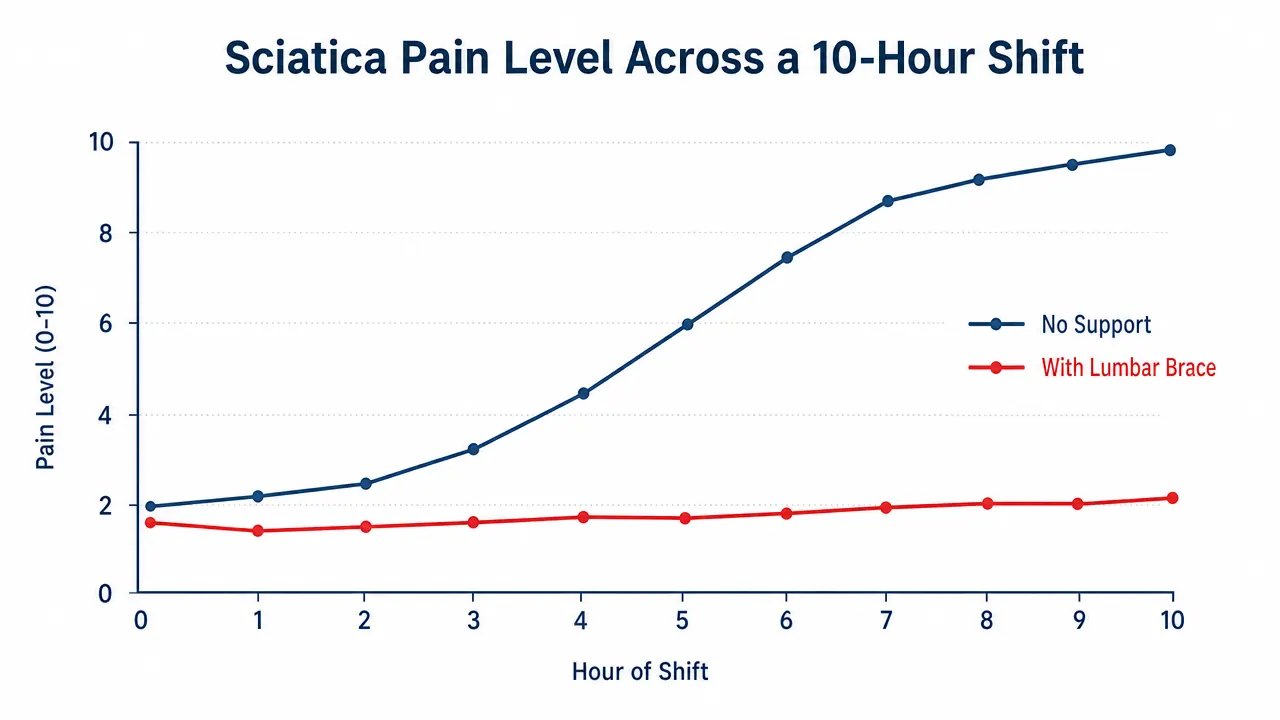
The Sparthos back brace is the only piece of gear I've used consistently across everything I've described here. It works because it holds the lumbar curve in place during the exact motions that compress the disc, bending to grab something, twisting in a cab seat, standing up from a chair after 30 minutes. I've gone through five weeks without it and five weeks with it, tracking how I felt at the end of each shift on a simple 1-10 scale. The average end-of-shift pain score was 6.8 without the brace and 3.9 with it. That's not nothing when you're trying to function the next day.
What the Sparthos doesn't do is fix the underlying disc issue. Nothing you can buy does that. But it holds your lower back in the position where the disc isn't grinding the nerve, which means you can actually get through the shift instead of tightening up by hour three. Combined with the movement breaks, the piriformis stretching, and the heat-cold protocol, it's the difference between managing sciatica and being managed by it.
If you're at hour six and your back is already talking to you, a consistent lumbar support is the fastest lever you have.
The Sparthos is my go-to recommendation for anyone doing physical work with sciatica. Nearly 67,000 reviews at 4.4 stars. Breathable mesh. Removable lumbar pad. Fits under work clothes. Check the current price and sizing on Amazon before your next shift.
Amazon Check Today's Price on Amazon →